We run the file for real and draw out even hidden behavior
Documents and scripts run on our own lightweight hypervisor and are judged by their behavior. New threats with no signature are caught too.
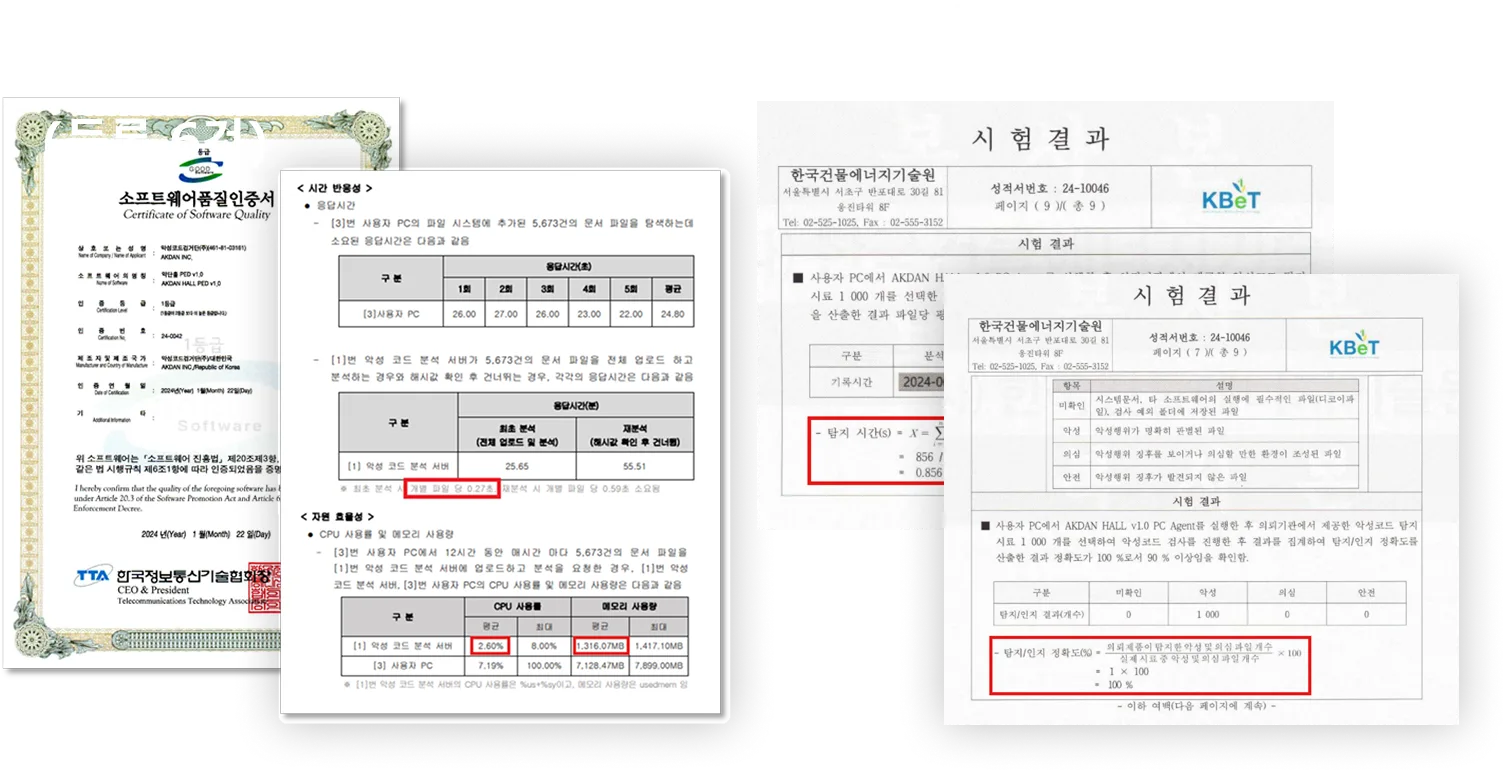
0.27 sAnalysis time per fileKBeT V&V · others average 60 s
2.6%CPU usage per fileKBeT V&V test certification
1MFiles processed per dayOn one 8-core server · others average 40,000
99%Detection rate for recent malware250,000 recent MalwareBazaar samples from 2022 onward
$0Analysis license costNo OS or Office licenses needed for analysis
4 coresMinimum analysis server specRuns on a standard server, no high-end hardware
Limits of legacy sandboxes
Legacy sandboxes can't keep up with the growing volume of AI threats
Speed60+ seconds per fileWhen mail and files pile up, bottlenecks mean only some get inspected.→ 0.27 s Hyper Sandbox
EvasionDetects the analysis environmentMalware spots the analysis through VM detection, demands for user interaction and delayed execution, then hides.→ Agentless · adaptive environment
FragmentationVersions can't be reproducedThe different OS and app versions on each company PC can't all be reproduced in a virtual environment.→ Observes many OS/app versions
CostServer and license burdenRequires OS and Office licenses and high-performance servers with about 5 GB per sandbox.→ $0 licenses · from 4 cores
Core technology
Three technologies that don't miss evasive threats
01 · High-speed · agentless
Sandbox analysis technology
Our own lightweight hypervisor rapidly observes behavior across multiple OS and app versions. With no agent inside the VM, it resists sandbox detection and sleep-based bypasses.
02 · Forced execution of threat elements
Latent threat detection technology
Forces buttons, hyperlinks and macros inside documents to run, drawing out malicious behavior that hides until a click.
Detection case · We ran a hidden hyperlink in an APT37 ‘Artemis’ HWP document and caught concealed PowerShell activity. Selected as a 2025 KISA excellent information security technology.
03 · Blocks VM-detection evasion
Adaptive environment technology
Changes the analysis environment on every run and places decoy Office files and vulnerability traps, blocking evasion that tries to detect the environment.
Vulnerability traps
Decoys that expose malware the moment it touches them, laid throughout the analysis environment
Even hidden malware has to touch certain points to attack. We set a trap at each one and record the moment it's accessed.
Vulnerability detection trapDecoys modeled on the OS and app vulnerabilities attackers target. When a malicious document touches one, the cell turns red and is kept as verdict evidence.Unauthorized memory access trapDecoy code and a read-only call stack in memory catch unauthorized access in real time, also exposing fileless attacks and processes posing as legitimate.
Analysis flow
Known threats fast, unknown threats deep
Known threats are screened out by the pre-filter first; only the remaining files get deep analysis in the Hyper Sandbox. AI maps behavior to MITRE ATT&CK techniques, scores the risk and hands it to SOAR · SIEM as report.json.
File intakeMail · cross-domain · endpoint
01 · KNOWNPre-filterKnown threats are screened out first so analysis can focus on unknown threats.
ReputationURL analysisSignatures (AV)YARA rules
Known threats screened out here first
02 · UNKNOWNHyper Sandbox behavior analysis
Behavior event executionForced button and hyperlink execution
Memory analysisCALL STACK · HEAP · SEH
Threat model simulatorOS · app vulnerability traps
Detection names that cover every stage of an attack
505 detection names mapped to ATT&CK cover 120 techniques and all 14 Enterprise tactics. By tactic, Defense Evasion (299) and Execution (239) have the most detection names.
505ATT&CK-mapped detection names
120ATT&CK techniques
14/14All Enterprise tactics
Based on the 505 of 576 detection algorithms that have a technique ID. The 120 techniques include sub-techniques (69 parent techniques). One detection name can span several tactics, so the per-tactic total is larger. As of ZX-CORE 2026.10.13.
Detection names by tactic
Defense Evasion299
Execution239
Command and Control65
Persistence45
Privilege Escalation43
Initial Access37
Discovery24
Impact18
Lateral Movement11
Credential Access7
Resource Development6
Exfiltration6
Collection5
Reconnaissance3
Field comparison test
10 new malware samples, compared with 3 existing antivirus products
We ran 10 new samples that actually arrived in February 2026 through 3 antivirus products and ZX. The antivirus products caught 1, 0 and 5; ZX judged all 10 within 2 seconds (0.4 s on average).
New malware sample (arrived 2026.02)
Vendor A
Vendor B
Vendor C
ZX
DHL Express_Awb….xls
Missed
Missed
Missed
0.07 s
Purchase order FXT….xls
Detected
Missed
Missed
0.09 s
IMAGEN_209143.vbs
Missed
Missed
Missed
1.97 s
RFQDocuments.vbs
Missed
Missed
Detected
0.30 s
ilie.rtf
Missed
Missed
Missed
0.55 s
WellsFargo_Estatement….lnk
Missed
Missed
Detected
0.03 s
result.hta
Missed
Missed
Detected
0.17 s
Order_354545….docx
Missed
Missed
Detected
0.34 s
Installer_4017.bat
Missed
Missed
Missed
0.36 s
HSWMP.bat
Missed
Missed
Detected
0.11 s
Detections
1 / 10
0 / 10
5 / 10
10 / 10
* In-house field test of 10 new samples that arrived in 2026.02 · compared with 3 major domestic and international antivirus products (undisclosed) · timeouts counted as misses
Certified tests and patents
TTA GS Certification Grade 1 and KBeT test figures (file analysis 0.27 s · CPU 2.6%) are taken directly from the test reports. Selected as a 2025 KISA excellent information security technology, with 12 registered patents, 14 applications and 1 PCT application.
Figures taken from official test reportsKBeT test: file analysis 0.27 s · average CPU usage 2.6% · detection accuracy 100%. TTA GS Certification Grade 1.
TTAGS Certification Grade 1100% in detection accuracy testing
KBeTV&V test certificationDetection time 0.27 s · CPU 2.6%
KISA2025 excellent information security technologyLightweight hypervisor-based detection of unknown malware
Patents12 registeredVirtualized analysis of malicious macros, obfuscated script detection, CPU bursting detection, memory prediction detection, malicious URL detection and more · 14 applications · 1 PCT